Family travel guide
Family beaches without a fake top-twenty
The old URL promised the twenty best beaches in the world for kids. The useful version is a way to judge shelter, shade, toilets and the walk back to the room.
The internet still asks for the twenty best beaches in the world for kids. It is a bad question dressed as a useful one. Beaches are not comparable like hotels on a spreadsheet. A lagoon in Fiji, a patrolled Australian bay, a Balinese path with outriggers, and a city beach at Glenelg share sand and they share almost nothing else. Wind, swell, toilets, the length of the walk from the car, and whether you can see the child when you sit down — those are the variables. A numbered list hides them.
This guide keeps the heritage address and throws away the ranking. If you came here with a toddler and a school holiday, you need a method. The method is to judge a beach as infrastructure. If the infrastructure is kind, the afternoon can be slow. If the infrastructure is a postcard with a riptide, the afternoon will be work.
What a family beach actually is
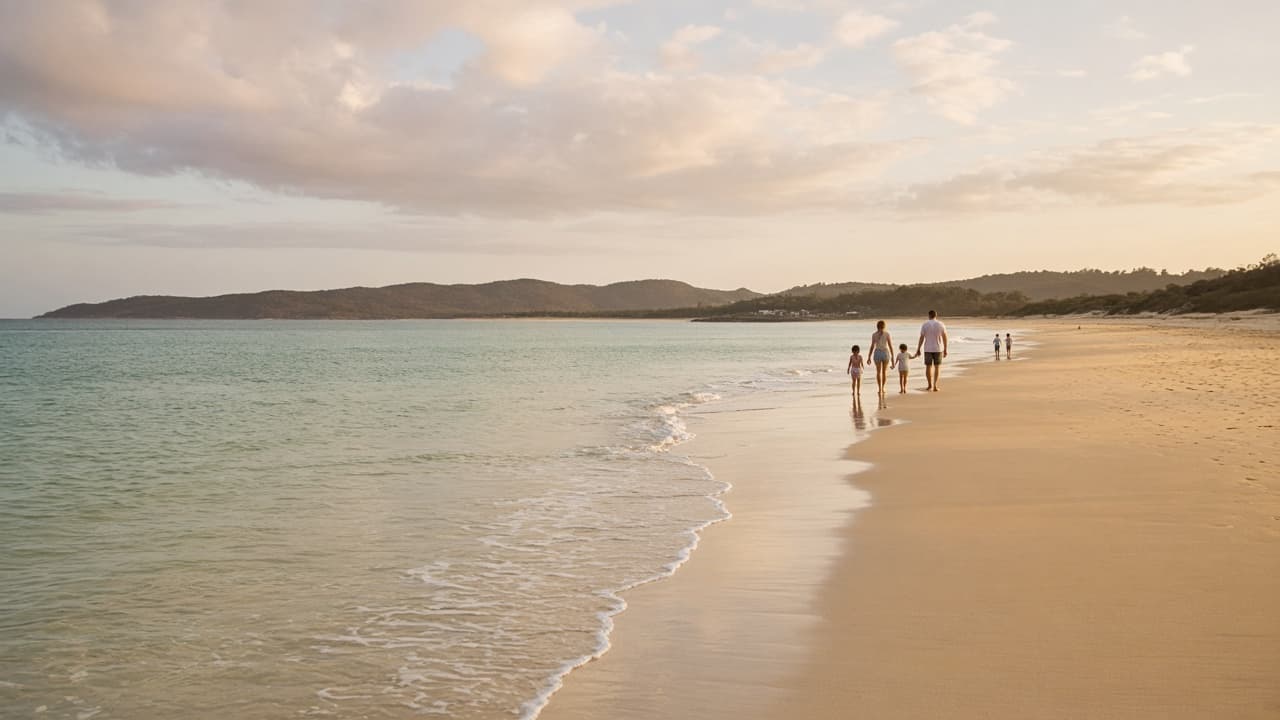
A family beach has a story a small child can understand with their feet. The water gets deeper gradually. There is a place to sit that is not a dune in full sun. There is a toilet that does not require a twenty-minute expedition. There is a way back to food, shade or a room that does not climb a cliff. There may be a patrol flag on Australian coasts; there may be a lagoon shelf on a Pacific island. The common idea is a gradient you can negotiate while holding a sandwich.
A famous beach is often the opposite. Fame attracts swell-seekers, drones, and people who will not move their towel. Fame is a signal that photographers got a dramatic sky. Children do not need a dramatic sky. They need to put a cup in a hole and not be knocked over by a dumping wave.
When you research, ignore “best.” Search for bay, lagoon, estuary, patrol, shade, and the walking distance from accommodation. Read a tide chart if the beach is tidal. Read a surf-life-saving or local council page on the day you go. This essay cannot see this morning’s swell.
Shelter, swell and the lie of the wide horizon
Open beaches photograph well because the horizon is a straight line. That line is often a machine for wind and dump. Toddlers eat sand in wind. Hats leave. Eyes stream. A wide beach can still be kind if a headland breaks the swell, if a river mouth creates a flat, if you go in the hour when the wind has not yet stood up. It is unkind if you arrive at 1pm because that was when parking freed up.
Sheltered beaches look smaller on Instagram. They are usually the right size for a family. You can see the child. You can see the bag. You can see the person who said they would only be in for a minute. Use that visibility as a design requirement, not a nice extra.
Shade is not a luxury
Unshaded sand becomes a stove. Families then huddle under one rented umbrella like a group of people who did not plan. Bring shade if the beach has none. Sit near the trees if the beach has trees. Leave if the combination of glare and heat is turning the outing into an endurance sport. We are not offering medical advice about sunburn or heat. Healthdirect is the Australian health information service. We are offering a planning rule: if you cannot describe the shade, you do not yet have a family beach.
Middle-of-the-day swimming is a choice you can often refuse. Morning beaches are cooler, emptier, and closer to the nap. Late beaches can work if dinner is allowed to be sandwiches. The families who “do not do well at the beach” are sometimes families who only go at 2pm in January.
Toilets, water and the walk
Plot the toilet before you plot the swim. A child who needs a toilet cannot negotiate a long, hot walk with a parent who wanted one more photograph. Drinking water is the same plot. If you must carry all of it, carry more than optimism suggests.
The walk from the room or the car is part of the swim. A beach that is “right out front” will be used twice a day. A beach that is a forty-minute drive plus a sandy track will be used once, in a worse mood. For toddlers, proximity beats purity. A slightly brown estuary you can reach in five minutes will beat a turquoise bay you arrive at already tired.
Prams hate soft sand. Carriers forgive it. If the access is a boardwalk, you have more options. If the access is a dune, decide whose back is the infrastructure.
Patrols, flags and humility
On many Australian beaches, surf life saving clubs set flags. The flags are not décor. They mark the place someone is watching and the place the water is being judged that hour. Swim between them when they are there. If they are not there, you do not have a patrol. That does not make the water evil. It makes you the entire safety system. If you are not willing to be that system, pick a pool, a lagoon, or a bay you already know.
This is not a drowning lecture and it is not a first-aid class. It is a reminder that blogs do not stand on the sand with a tube. Local advice on the day wins. If a beach has a reputation for rips, believe the reputation until a local authority tells you otherwise.
How this maps onto the old list
The heritage title implied a world tour of kid beaches. The honest world tour is a set of types. Type one: suburban bay with a playground behind it (Glenelg’s logic, some Sydney harbour corners). Type two: patrolled Australian surf beach where you use the flagged patch and ignore the rest (parts of the Gold Coast, many holiday coasts). Type three: tropical lagoon with a standing-depth shelf (the Fiji product when it is real). Type four: a walking path beside calm water rather than a surf beach at all (Sanur’s logic). Type five: a hotel pool that is doing the job the sea cannot.
You can take children to wild beaches. You should do it with more adults than children, more exits than plans, and no need for the child to love it. Wild is for the adults. Family is for the shelf.
Bali, Fiji, Coolangatta, Glenelg and Fremantle’s waterfront all appear on this site because the archive kept returning to them. None of them win a trophy here. They are case studies. A Coolangatta corner can be kinder than a wilder kilometre of the same coast. A Glenelg promenade can be the beach for a child who mostly wanted a tram. A Fiji lagoon can make the sea irrelevant. That is allowed.
A practical hour on any new beach
Arrive, stand still, and look for four things: where the water is quietest, where the shade is, where the toilet is, and where you would go if someone cried. Put the bag in the shade. Put a hat on. Offer water. Then let the child approach the water at their own speed. Do not throw them in for the photo. Do not negotiate with a dumping wave because other families seem unbothered. Leave while it is still good if you can bear the social pressure of leaving.
If you need a destination after this method, go to the destinations hub and pick a coast whose ordinary afternoon you can describe. If you cannot describe it, you are still shopping for a ranking. Rankings are how adults outsource judgement. Children do not care which number you found. They care whether the sand was too hot and whether you had time to dig.
A morning on a beach you have not met yet
You arrive before the wind stands up. You do not unfold every towel at once. You walk to the water’s edge with one adult and one child and you look at the slope with your feet. If the first three steps are a dump, you do not negotiate. You go to shade and you reassess. Maybe the pool is the ocean today. Maybe a bay around the headland is the ocean. Maybe you eat the sandwiches and call it a waterfront picnic. That is still a beach day. The ranking you did not find on this page cannot make a dumping wave polite.
Take a photograph if you want, after the hats are on and the water is understood. The photograph is not the test. The test is whether you would come back tomorrow at the same hour.
What to verify on the day, every time
Patrol flags, council notices, weather warnings, and the walk from wherever you left the water bottles. If you are in Australia, surf life saving information is live. If you are in another country, local flags and hotel notices are live. This essay is not. If a beach is closed, it is closed. If a current advisory says stingers, rips, or pollution, you do not need a second opinion from a travel site.
What the heritage title got wrong
It implied a world you could consume as twenty trophies. Children do not consume coasts that way. They consume whether the sand was too hot and whether an adult sat down. Keep the URL. Lose the trophy. Choose shelter.
Ask a planning question
This is an independent guide, not a booking desk. If a page is unclear, or you want a topic added, send a note — we read every message.